
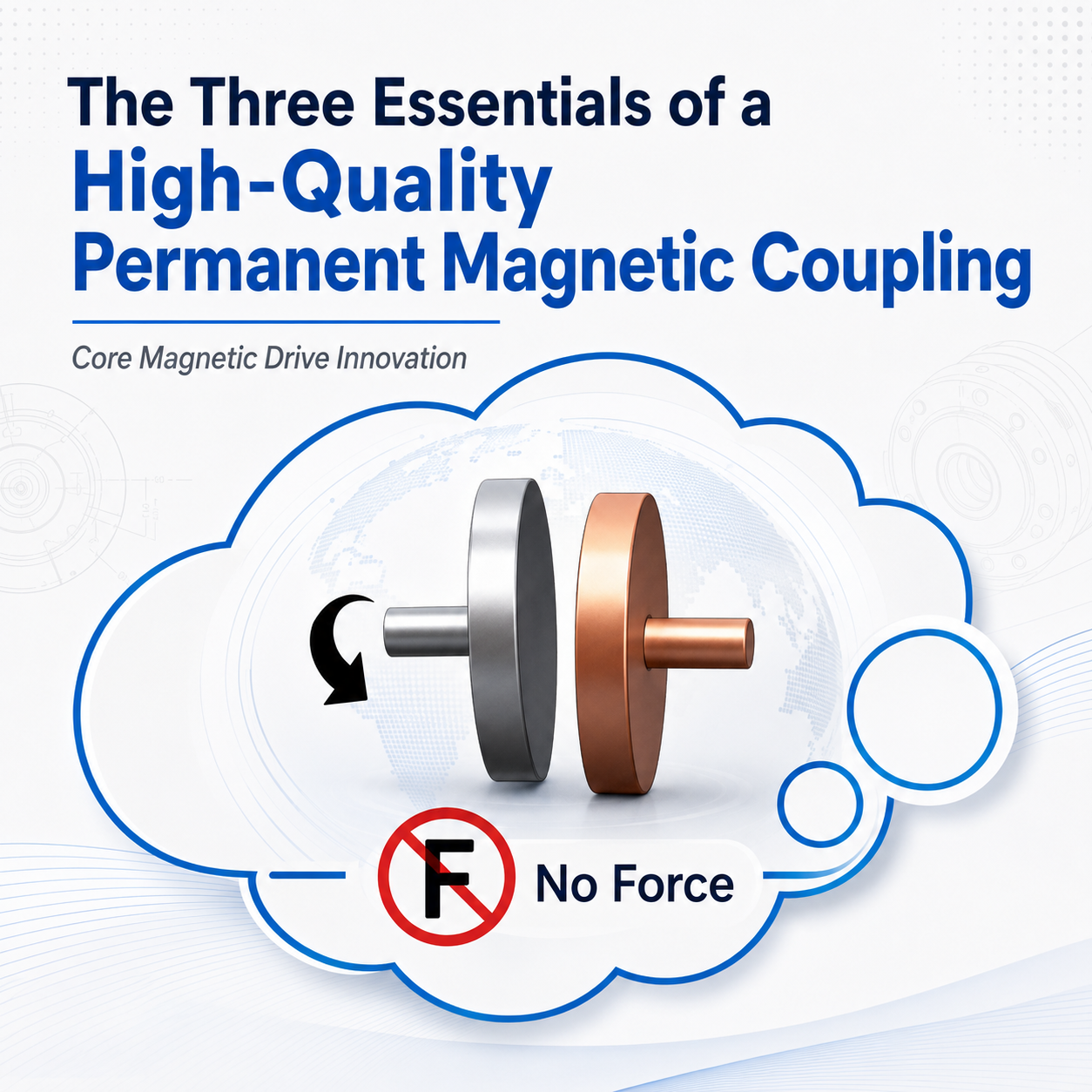
Permanent magnets are widely used in industrial equipment because they can transmit force without direct physical contact. As a major producer of rare-earth permanent magnetic materials, China has strong material and manufacturing foundations for developing advanced magnetic machinery.
Magnetic machinery has significant potential in industrial transmission, energy conservation, equipment protection and intelligent manufacturing. Within this field, permanent magnetic drive technology plays a particularly important role.
The electric motor is often described as the heart of industrial equipment. In the same way, a coupling can be viewed as the artery connecting the motor to the driven machine. Its performance directly affects transmission efficiency, equipment stability, operating safety and maintenance costs.
Permanent magnetic couplings introduced a new concept to industrial transmission: contactless torque transfer. Although this technology attracted considerable attention, conventional designs have not always fully realized the natural advantages of magnetic transmission.
After years of technical research, Shaanxi Jiebang developed a self-excited, coreless permanent magnetic transmission architecture. The company also proposed three essential qualities that define a high-quality permanent magnetic coupling.
What Are the Three Essentials?
The three essentials are:
- The rotors should not magnetically attract each other.
- All forms of energy loss should be minimized.
- Flexible transmission should provide genuine impact cushioning.
Together, these principles address some of the most persistent problems in industrial power transmission.
Essential 1: No Magnetic Attraction Between the Rotors
One of the most important advantages of magnetic transmission should be the separation of the driving and driven components.
However, conventional mutual-excitation magnetic circuit structures may create strong magnetic attraction between the two rotors. This attraction can produce inter-shaft force, placing additional loads on the motor shaft, driven shaft, bearings and seals.
Inter-shaft force may contribute to:
- Bearing wear
- Seal damage
- Shaft misalignment
- Increased vibration
- Higher maintenance requirements
- Premature component failure
- Potential shaft breakage
Industrial transmission systems often have strict alignment requirements. Even when equipment is aligned correctly during installation, foundation movement, thermal expansion, vibration and long-term operation can gradually create alignment deviations.
If a coupling continuously transfers additional radial or axial forces between the shafts, these deviations may accelerate equipment wear.
The self-excited architecture developed by Shaanxi Jiebang is designed to generate torque primarily in the rotational direction. By eliminating the structural conditions that create rotor-to-rotor magnetic attraction, the system avoids the source of inter-shaft force.
This allows magnetic transmission to perform its primary function without creating additional loads on the connected equipment.
Essential 2: Low Losses for Long-Term Efficiency
Energy efficiency is another critical requirement for permanent magnetic transmission.
Some conventional permanent magnetic couplings use iron plates or magnetic cores as part of the magnetic circuit. When these components operate in a changing magnetic field, they may generate eddy-current losses and hysteresis losses.
These losses can lead to:
- Reduced transmission efficiency
- Higher equipment temperature
- Additional cooling requirements
- Increased energy consumption
- Accelerated material aging
- Lower long-term operating value
Heat generation is not only an efficiency problem. Higher operating temperatures may also affect bearings, lubricants, seals and surrounding equipment.
Shaanxi Jiebang’s coreless design avoids the use of conventional iron-core structures in key transmission areas. This helps reduce iron loss and unnecessary heat generation.
According to the technical information provided, the transmission efficiency of the self-excited coreless design is approximately two percentage points higher than products designed only to meet existing national standard requirements.
Even a relatively small improvement in transmission efficiency can generate considerable savings in continuously operating industrial equipment.
The value becomes especially significant in:
- Cement production
- Mining equipment
- Fans and pumps
- Conveying systems
- Rotary kilns
- Chemical processing
- Power generation
- Metallurgical production
For high-power equipment operating for thousands of hours each year, efficiency gains can reduce both electricity costs and carbon emissions.
Essential 3: Genuine Flexible Transmission
Flexibility is not simply a marketing term. A truly flexible coupling should absorb or reduce the impact caused by starting, stopping, load fluctuations and temporary overloads.
Industrial equipment is frequently exposed to:
- Sudden load changes
- Start-up torque shocks
- Process blockages
- Speed fluctuations
- Vibration
- Installation deviations
- Emergency shutdowns
A rigid transmission path transfers these impacts directly between the motor and the driven machine. This can increase stress on shafts, bearings, gears and other components.
A permanent magnetic coupling should use the non-contact nature of magnetic force to create a flexible transmission relationship. The system should reduce sudden mechanical impact while maintaining stable torque transfer.
Shaanxi Jiebang emphasizes that flexibility must provide real cushioning value rather than being presented as an additional feature without reliable engineering support.
A properly designed flexible magnetic transmission system can:
- Reduce start-up impact
- Protect motors and driven equipment
- Improve operational stability
- Reduce vibration transmission
- Extend component life
- Lower maintenance costs
Why the Three Essentials Matter
The three essentials create a practical method for assessing whether a permanent magnetic coupling genuinely reflects the physical advantages of magnetic transmission.
A suitable product should not merely transmit torque. It should also reduce harmful forces, minimize energy loss and protect the transmission system.
When evaluating a permanent magnetic coupling, users should therefore ask:
- Do the rotors attract each other?
- Does the coupling introduce inter-shaft force?
- Does the magnetic circuit contain loss-generating iron components?
- How much heat is generated during operation?
- Does the product provide measurable flexible cushioning?
- Can it tolerate installation deviations?
- Is the coupling easy to install and maintain?
- Are its claimed functions supported by testing and data?
These questions help users distinguish between fundamental technical advantages and superficial product features.
Supporting Industry Standardization
Existing standards for permanent magnetic couplings have not always included complete evaluation requirements for inter-shaft force, flexibility and energy loss.
To address this gap, Shaanxi Jiebang participated in the development of the group standard Technical Requirements and Test Methods for Permanent Magnetic Couplings.
The standard defines important indicators and testing methods related to:
- Inter-shaft force
- Flexible transmission
- Energy loss
- Product performance evaluation
Clear standards help manufacturers, users and testing organizations evaluate products using measurable data rather than relying solely on promotional claims.
They also support the long-term development of a more transparent and technically responsible industry.
Conclusion
The potential of permanent magnetic transmission lies in its ability to transmit torque without direct contact. To realize this potential, coupling design must follow the essential physical behavior of magnetic fields.
The three essentials proposed by Shaanxi Jiebang provide a clear technical direction:
- No attraction between the rotors
- Low operating losses
- Genuine flexible transmission
A permanent magnetic coupling that meets these principles can reduce inter-shaft force, improve efficiency, cushion mechanical impact and create greater long-term value for industrial users.
By anchoring product development to these three essentials, permanent magnetic transmission can move closer to its full technical potential.