
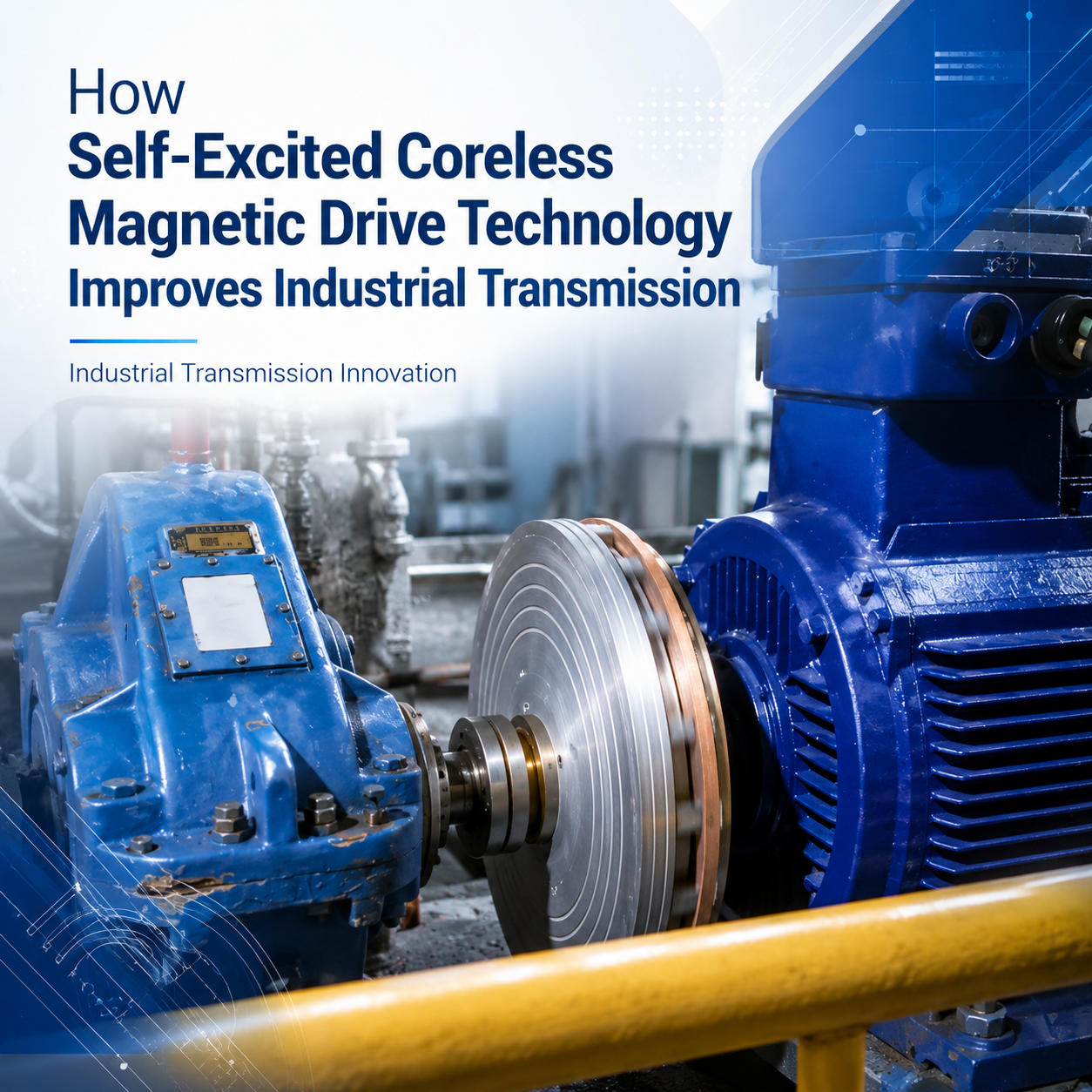
Industrial transmission systems must operate under demanding conditions. Motors and driven machines may run continuously, experience fluctuating loads and operate in dusty, humid, hot or vibration-intensive environments.
The coupling connecting these components is small compared with the entire machine, but its influence is significant. An unsuitable coupling can increase vibration, bearing wear, energy consumption and maintenance frequency.
Permanent magnetic couplings offer a different approach from conventional mechanical couplings. Instead of transferring torque through direct physical contact, they use magnetic interaction to transmit power across an air gap.
This contactless transmission principle has several potential advantages:
- Reduced mechanical wear
- Lower maintenance requirements
- Improved equipment isolation
- Flexible power transmission
- Better tolerance of certain installation deviations
- Reduced vibration and impact
However, the actual performance depends heavily on magnetic circuit design.
Shaanxi Jiebang developed a self-excited coreless permanent magnetic transmission technology to overcome limitations found in conventional mutual-excitation structures.
Limitations of Conventional Mutual-Excitation Designs
Many conventional permanent magnetic drive systems use a mutual-excitation magnetic circuit. In this configuration, the conductor rotor may require an iron backing plate or magnetic return structure.
Although this arrangement can transmit torque, it may introduce several technical problems.
Strong Rotor Attraction
The two rotors may generate strong magnetic attraction. This force is not part of useful rotational torque, but it can be transmitted into the shafts and connected equipment.
The resulting inter-shaft force may increase loads on:
- Motor bearings
- Driven-machine bearings
- Shaft seals
- Mounting structures
- Supporting foundations
This undermines one of the most important expectations of contactless transmission: reducing harmful interaction between the two shaft systems.
Iron Loss
When iron components operate in an alternating or changing magnetic field, eddy-current and hysteresis losses may occur.
These losses convert useful energy into heat, lowering the overall efficiency of the transmission system.
The resulting temperature increase can require additional cooling and may negatively affect nearby components.
Difficult Alignment
Conventional structures may require precise rotor alignment and positioning. Installation becomes more complicated, and maintaining this alignment during long-term operation can be challenging.
Questionable Auxiliary Functions
Some products promote soft starting and torque limitation as major features. However, the practical value of these functions depends on the overall system design, operating sequence, lubrication, sealing and protection strategy.
If an auxiliary function lacks reliable engineering support, it may fail to protect the equipment as expected.
The Self-Excited Magnetic Circuit
The self-excited structure developed by Shaanxi Jiebang changes the way the magnetic circuit is created.
Instead of relying on two rotors that strongly attract each other, the magnetic circuit is concentrated in a way that supports torque generation in the rotational direction while reducing unwanted forces in other directions.
The objective is not simply to improve an existing structure. It is to rebuild the relationship between the magnetic field, conductor rotor and transmission direction.
This architecture is designed to provide:
- Effective torque transmission
- Minimal rotor-to-rotor attraction
- Reduced inter-shaft force
- Lower structural complexity
- Easier installation
- Improved operational safety
By addressing the magnetic circuit at the architectural level, the technology aims to eliminate the root cause of several conventional transmission problems.
Why the Coreless Design Matters
The coreless configuration is another important part of the technology.
Traditional iron-core structures may produce:
- Eddy-current loss
- Hysteresis loss
- Heat accumulation
- Reduced efficiency
- Additional thermal stress
Removing the iron core from key areas of the magnetic transmission path helps prevent these losses.
The benefits include:
Higher Transmission Efficiency
More input energy can be converted into useful output torque instead of being lost as heat.
Lower Operating Temperature
Reduced iron loss helps limit unnecessary heat generation, lowering the thermal burden on the system.
Lower Energy Consumption
When applied to continuously operating high-power equipment, improved efficiency may create substantial annual energy savings.
Longer Equipment Life
Lower temperatures and reduced additional forces may help extend the service life of bearings, seals and other components.
Eliminating Inter-Shaft Force at the Source
Inter-shaft force is a long-standing challenge in industrial transmission.
Mechanical misalignment may result from:
- Installation errors
- Foundation settlement
- Temperature changes
- Shaft deformation
- Equipment vibration
- Long-term wear
If a coupling transfers additional forces between the motor and driven machine, alignment deviations may become more damaging.
The self-excited coreless design is intended to avoid magnetic attraction between the driving and driven rotors. Torque is produced in the desired rotational direction without introducing significant force in other directions.
This can help:
- Reduce bearing stress
- Minimize abnormal wear
- Lower vibration
- Protect shafts and seals
- Simplify alignment requirements
- Improve long-term system stability
Rather than managing inter-shaft force after it occurs, the technology removes its structural cause.
Easier Installation and Maintenance
Installation efficiency is an important consideration for industrial users.
When the driving and driven rotors remain relatively independent, technicians do not need to overcome strong magnetic attraction during assembly.
This can make the product easier to:
- Position
- Align
- Install
- Remove
- Inspect
- Replace
The non-contact transmission structure also reduces the number of wear-prone components.
In many applications, routine maintenance is mainly focused on checking fasteners and the surrounding equipment rather than servicing the coupling body itself.
This can reduce:
- Scheduled maintenance time
- Spare-part requirements
- Lubrication needs
- Equipment downtime
- Labor costs
Improved Safety Under Abnormal Conditions
Industrial equipment may occasionally experience loose fasteners, displacement or accidental contact between components.
A coupling design should limit damage when abnormal conditions occur.
The self-excited coreless architecture is designed so that the driving and driven components do not remain locked together through rigid contact. If scraping or interference occurs, the structure can help limit the escalation of damage.
This provides an additional layer of protection for the transmission system and surrounding equipment.
Application Results in Industrial Equipment
A reported application involved a 5,000-ton-per-day rotary kiln production system.
Before the modification, restarting the kiln after a failure generated significant direct energy and fuel costs. With approximately two failures per year, the direct annual cost reached a substantial level, while indirect losses caused by production interruptions were even more difficult to calculate.
After the permanent magnetic coupling upgrade, the equipment reportedly achieved:
- More stable operation
- Reduced maintenance of the motor and gearbox
- No routine maintenance requirement for the coupling body
- Elimination of oil-leakage risks associated with the previous system
- Easier installation
- Reduced impact from alignment deviations
- Direct and indirect economic benefits
The case demonstrates that the value of permanent magnetic transmission extends beyond electricity savings.
Additional benefits may include:
- Reduced downtime
- Lower environmental risk
- Fewer equipment failures
- Lower maintenance costs
- Improved production continuity
Supporting Green Industrial Development
Energy efficiency and carbon reduction have become important priorities for industrial manufacturers.
By reducing iron loss, heat generation and mechanical wear, self-excited coreless magnetic transmission can support lower lifecycle energy consumption.
Its potential environmental benefits include:
- Lower electricity consumption
- Reduced cooling requirements
- Less lubricant consumption
- Fewer replacement parts
- Longer equipment life
- Lower maintenance-related material use
- Reduced carbon emissions over the equipment lifecycle
This makes the technology relevant to industries pursuing both operational efficiency and environmental performance.
Future Development of Magnetic Machinery
Magnetic machinery combines knowledge from electromagnetism, mechanical engineering, materials science, thermal management and industrial equipment design.
As industrial systems become more efficient and intelligent, magnetic transmission may be used in a wider range of applications.
Potential areas include:
- Pumps
- Fans
- Conveyors
- Crushers
- Rotary kilns
- Mining machinery
- Chemical equipment
- Power-generation equipment
- Metallurgical machinery
- High-load industrial drive systems
Shaanxi Jiebang continues to develop magnetic transmission technologies according to a simple engineering principle:
Reasonable design is the foundation of reliable quality.
This principle emphasizes that product performance should originate from sound physical architecture rather than from additional complexity or unsupported claims.
Conclusion
Permanent magnetic transmission has the potential to improve industrial efficiency, equipment reliability and maintenance performance. However, these benefits depend on whether the product design follows the fundamental laws of magnetic circuit operation.
Shaanxi Jiebang’s self-excited coreless technology addresses conventional limitations through a redesigned magnetic architecture.
Its main technical objectives include:
- Eliminating inter-shaft force
- Reducing iron loss
- Improving transmission efficiency
- Simplifying installation
- Reducing maintenance
- Providing flexible torque transmission
- Improving equipment safety
By solving problems at their structural source, the technology offers a practical path toward safer, more efficient and more sustainable industrial transmission.